Wylie and the Odyssey, Part 2


To update this post concerning Wylie and Amazon’s recent deal, here’s a long quote from The Guardian:

Fear and loathing among the movers and shakers of America’s publishing industry reached new heights late last night with both Random House and Macmillan denouncing top literary agent Andrew Wylie’s move into digital publishing.
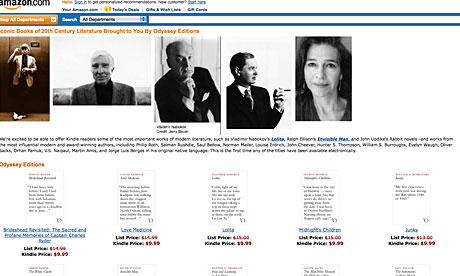
Home to 700 authors and estates, from Philip Roth to John Updike, Jorge Luis Borges and Saul Bellow, the Wylie Agency shocked the publishing world yesterday when it announced the launch of Odyssey Editions. The new initiative is selling ebook editions of modern classics, including Lolita, Fear and Loathing in Las Vegas and Updike’s Rabbit tetralogy, exclusively via Amazon.com’s Kindle store, leaving conventional publishers out of the picture.
The disintermediation provoked an immediate reaction from Random House, which publishes a number of the authors featured in Odyssey Editions in physical form. On learning of the new venture on Wednesday night, the publisher fired off a letter to Amazon “disputing their rights to legally sell these titles”, which it said were “subject to active Random House publishing agreements”.
And late yesterday evening the publisher went a step further, with spokesman Stuart Applebaum issuing a statement saying that “on a worldwide basis”, Random House “will not be entering into any new English-language business agreements with the Wylie Agency until this situation is resolved”.
At the very least, this will be interesting to watch. Me, I’m staying out of this fight.

Would you rather own books or words in a cloud?

 http://www.doonesbury.com/strip/dailydose/

Thanks to Ros Lawler over at Random House, we found this link to an article in The Olympian.

Best quote: “[T]he neurological phenomenon of reading is centered in a location of the brain that appears to have no preference for media, other than black words against a white background.” From Stanislas Dehaene.

Books and Apps


Marcus du Sautoy, the author of The Num8er My5teries: A Mathematical Odyssey through Everyday Life, writes a long and interesting post on apps and their relationship to literature, non-fiction and children’s books.

Taking Wolf Hall and Alice’s Adventure’s in Wonderland (the apps) as starting points, he makes a strong case for the integration of rich media into literature. He briefly suggests that novelists should consider multiple-platforms at the conception of their work, and just as quickly moves on to explore the potential for non-fiction writers.

I wish he had stood still for a moment. In original enhanced fiction, not interactive footnote references, animated illustrations for children, adaptations for the iPad, or video interviews with the author, lies the greatest potential for rich media fiction. Bring on the literary apps - a few text-based literary journals on the iPad just aren’t doing it for me.

http://www.guardian.co.uk/books/2010/jul/03/marcus-du-sautoy-apps-books

Principles for Digital Publishing

Stephen Page outlines a few principles for digital publishing in The Guardian. Interesting read.

Here are some:

1. Creating the greatest value for writers should lie in keeping their print and digital publishing in one place, as it is crucial for the promotion, publicity and management of texts – and for fair pricing. Publishers have to be imaginative partners across print and digital.

2. Publishers have to be clear that they will offer a fair return long-term to authors, and review royalty rates sensibly as the market develops. (This is already widespread in new contracts).

3. In the digital world, price is flexible 24/7. Publishers need to become expert in managing, not just setting, price in international markets.

4. The web offers a connection to niche readerships that can be spoken to directly, but only with great care. Publishers need to have direct conversations with readers through all available means, despite the fact that they won’t shop with us. Shopping’s not the point, connection to audience is the point.

5. Publishers will need to be passionate about boring data and thrilling technology. Excellent metadata – the information that governs and accompanies every copyright in the digital world – is crucial, as is an understanding of new technologies and the creative opportunities they offer writers.

6. Traditional news media has long driven a great deal of book-buying. But the means by which people find reading recommendations have changed and publishers need to join this new conversation while supporting and respecting it.

The Augmented Reality of the Book

The development of multi-platform books (or platform-optimized experiences, if you will) is one of my passions – not iPad books tacked on with author interviews, but books as immersive experiences, living in the mind, through text and music and art.

The video backdrop and rich soundtrack against which Nick Cave reads The Death of Bunny Munro comes very close to my imagining of this narrative world.

So does this video by Camille Scherrer, a design student at ECAL, the University of Art and Design Lausanne.

One day, when I’m reading a book on the iPad, I want a dark bird to fly across the page.

Custom Post Images